 |
|
|
Homepage
Company profile
Consulting services
Software products
Media / Publications
Contact us
|
KKW-Online 2.1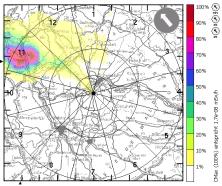
KKW-Online is a Linux-based system for monitoring the emissions of nuclear power facilities in real-time. The system is continuously fed data on radiology and meteorology, and provides information on the distribution of dosages in a 50km radius around the plant. In the unlikely event of a nuclear incident, the system can be used to assess which measures are necessary in the vicinity of the plant. A prognosis module can be used to predict the impact of the incident.
The system uses a simulation model based on the Lagrange theory unlike those of similar systems. In KKW-Online, previously emitted particles are carried from episode to episode, providing more accurate results than Gauss-based models.
The system is installed in the Bavarian Environmental Protection Agency, and was developed in collaboration with the Bavarian Ministry for Environmental Protection.
Online monitoring
The first of two main modules in KKW-Online is the Online Monitoring mode. This module continuously receives measured data on radiology and meteorology, and uses this data to simulate the dispersion of the released radioactive particles during the past 30-minute episode.
If a predefined threshold is exceeded for certain data fields, the system automatically switches from standard monitoring mode into alarm monitoring mode, and automatically informs the authorities via email and/or an electronic status signal.
Offline simulations
In this second module, the user can manually enter radiological and meteorological data into the system, and simulate user-defined "What-If" scenarios. Combined with prognistic data from national weather services, this module can be used to predict the impact of a hazardous release in the case of a nuclear incident.
Simulation results
The simulation models create result data in the form of data tables, recommended measures, charts, plots, interactive elements, and animations of concentrations and dosages during the past 24 hours. During Routine Mode - i.e. when the emissions are below predefined thresholds - the system offers result files from the last six episodes / three hours. In the case of a nuclear incident, the user can access all data accumulated since the beginning of the incident.
Accessibility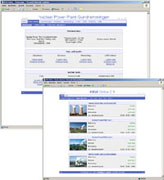
In the case of a nuclear incident, it is important for the KKW-Online system to be instantly available, and easily understandable, as to not add to the immense level of stress during such an incident.
To ensure that the system can be accessed from any workstation within the company intranet, KKW-Online's user interface is presented as a website: on any workstation, independant of hardware, operating system, or browser, the user can instantly access all functions of the system. This approach eliminates the need for platform-dependant front-ends requiring installation.
During the development of the user interface, great priority was placed on intuitivity. All functions and elements are clearly named and easy to locate within the system.
The user interface is locale-dependant, the user can currently switch between English and German locale tables.
Input data
The system KKW-Online II relies on input data at regular intervals, currently every 30 minutes. After extensive plausibility tests of the data, it is inserted into the database. For statistical analyses, all data is stored for eighteen months, and can later be queried by the user.
KKW-Online can be adapted to use any preinstalled relational database. Currently, the open-source database system MySQL is used.
Simulation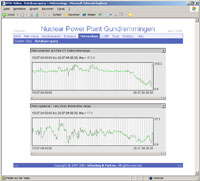
Periodically, the system simulates the atmospheric dispersion of nuclear emissions during the last half hour. Should the online data not be provided within a certain time range, the data of the previous episode is duplicated, to avoid interrupting the continuity of the monitoring due to a lack of data.
Unlike most other systems - which use a Gaussian approach - the numerical models devised by S&P use Lagrange particle systems. With this method, emitted particles from previous episodes are carried into the next episode, providing far more accurate results than other models.
The simulation models used in KKW-Online were developed exclusively for the system, and have been validated in a number of experiments according to federal guidelines.
Reliability and scalability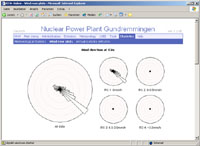
Once installed, KKW-Online can run for months and even years with hardly any need for maintenance. Internal system monitors constantly ensure that the entire system is running smoothly, for instance with memory checks, hard drive inspections, and process checks.
The system can be configured to run any number of nuclear plants, and supports cluster and multiprocessor solutions.
A version control system within the user interface allows the local administrator to ensure that the installed version has not been changed in any way since the installation approval.
History
KKW-Online was first released in 1997, following a request by the Bavarian State Ministry of Landplanning and Environment. It was replaced in 2002 by Version 2.0, which included an entirely new user interface, faster calculation and graphics modules, and numerous new tools.
Demo version
A demo version of KKW-Online is available on the internet for registered demo users at www.kkw-online.de, where the user can see and inspect the newest features. This demonstration system uses realistic data on meteorology and radiology, and demonstrates the system in standard monitoring mode. This demo version is not to be understood as an active online monitoring system.
|
| Disclaimer | |
| Copyright © 1993-2009 Schorling & Partner, All rights reserved | |
